
Precious Metal Insight
Committed to Helping You Succeed
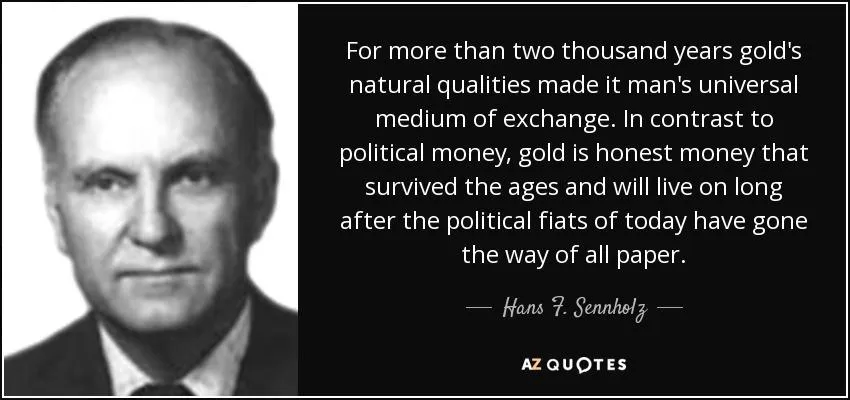
“The international monetary order is more precarious by far today than it was in 1929. Then, gold was international money, incorruptible, unmanageable, and unchangeable.
Today, the U.S. dollar serves as the international medium of
exchange, managed by Washington politicians and Federal Reserve officials, manipulated from day to day and serving politicians goals and ambitions. This difference alone sounds the alarm to all perceptive observers.”
– Hans F. Sennholz, PhD., Economics Professor
Experience you need. Information you want.
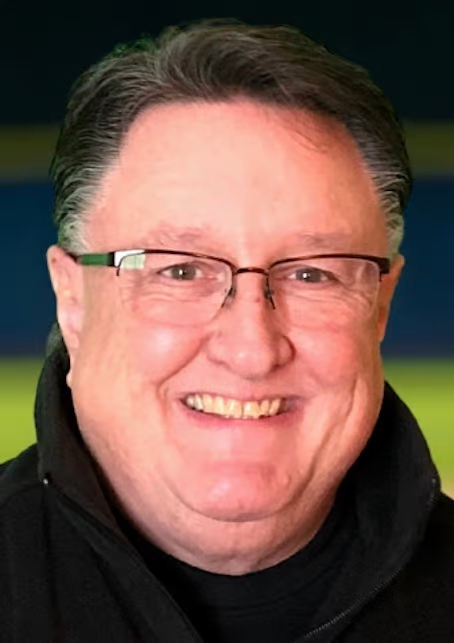
Hi, I’m Bobby Christy. I’m the Founder/CEO of TW3 Marketing.
I speak and write often on the current state of our economy, the stock market and well just about anything that’s on my mind.
I help people make sense out of today’s headlines. I do this by breaking down complex subjects into simple and understandable bite-sized pieces.
My strength is the ability to identify trends, patterns, and money-making opportunities when most people see only chaos, confusion, and white noise.
Early Days
I began my business career in Charlotte, NC in 1982 after leaving U.S. Marine Corps as a Captain.
I have a bachelor’s degree in economics from a prestigious northern university where I studied Economics under renowned Austrian School economist, Dr. Hans Sennholz.
I also hold an Advanced Degree in Theology.
Precious Metal Insight is a peek behind the curtain into this unusual market niche. What I offer is not advice, but only an opinion as to what I see going on in the world around us.
You Can Do This
Including precious metals in your investment portfolio can provide diversification, act as a hedge against market volatility, and preserve wealth over time. Gold, silver, platinum, and palladium each offer unique investment opportunities based on their properties and industrial demand.
Consider your risk tolerance, investment goals, and market trends when determining the appropriate
allocation of precious metals in your portfolio.
Ensure secure storage and consider insurance options to protect your valuable holdings.
By incorporating precious metals into your investment strategy, you can add stability, potential growth, and long-term value preservation.

Read Our Latest Thoughts
Lorem ipsum dolor sit amet, consectetur adipiscing elit.
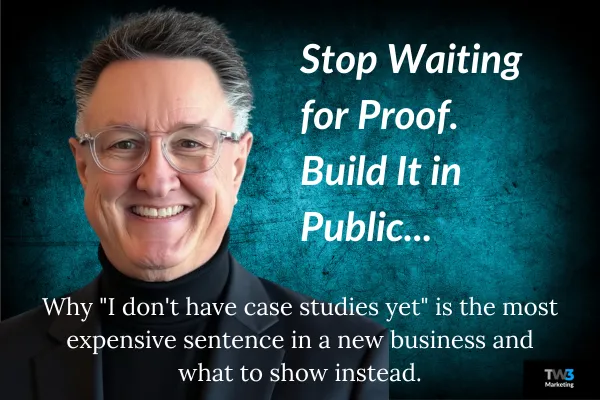
Stop Waiting for Proof. Build It in Public.
Stop Waiting for Proof. Build It in Public.
Why "I don't have case studies yet" is the most expensive sentence in a new business and what to show instead.
By Bobby Christy
I don't have proof yet.
That's what most owners say. New business. New offer. New pivot. New direction. The standard line is the same — as soon as I have a few wins under my belt, then I'll start showing up with real authority.
It sounds reasonable.
It's also the reason the wins take longer to show up.
Because waiting for proof creates a loop. You can't get clients without proof. You can't build proof without clients. So you sit at the start line, hoping that something — luck, a referral, a friend — will hand you the first win. Some people sit there for a year. Some sit for three.
While they're waiting, they're still being judged. Every prospect who finds them is running the same check the world runs on every business. Has this worked for someone like me?
If the answer isn't obvious, the prospect doesn't wait around to find out. They move on. Not because they're harsh. Because they have other tabs open.
Write this down. Buyers don't pause their evaluation while you build your portfolio. They evaluate you exactly as you are right now. The only question is what you show them in that moment.
The hesitation moment.
It plays out the same way every time.
A prospect lands on your page. They read what you do. They get curious. They want to believe this might be the answer. They're close.
Then they hesitate.
Not because they need more time. Not because the price scared them. Not because they "want to think about it." They hesitate because they're not convinced yet — and they have no easy way to get convinced.
That's the moment new businesses lose deals they should win. Not for lack of skill. For lack of visible skill.
The reframe most owners need.
Here's the part most people miss. Proof isn't something you earn later. Proof is something you build now.
You don't wait for testimonials. You build proof of how you think.
Testimonials and case studies are one type of proof — the type that compounds over years. There's another type that's available to you on day one. The type that has nothing to do with how many clients you've served and everything to do with how visibly you can solve the problem in front of you.
Proof of capability. Proof of understanding.
Most new businesses skip both because they're staring at the wrong scoreboard. They think proof means a logo wall. It doesn't. Proof means giving a stranger enough evidence that you know what you're doing to make the next step feel safe.
You can do that without a single closed deal.
Show your thinking.
Instead of waiting until you have results, show how you would get them.
Instead of saying I help businesses grow — which every business says, and no buyer believes — say something like here's how I would take a service business from 3 leads a week to 10 in 60 days. Then walk through it. The diagnosis. The first move. The second move. Why this approach instead of that one. What you'd watch for. What you'd cut.
That isn't speculation. That's proof of capability.
A buyer reading that doesn't need a testimonial to know whether you understand the problem. They can hear it in your reasoning. They can feel the difference between someone who's done the work in their head a hundred times and someone who's reciting a marketing playbook.
Capability is visible long before results are.
Use real scenarios.
The other lever is proof of understanding.
Use past experience, yours, or work you observed up close in a previous role. Use hypothetical breakdowns of the kind of problem your ideal buyer is sitting in. Use before-and-after thinking that maps the buyer's current reality to the future they're looking for.
Here's what most contractors are doing wrong on their Google profile right now. Here's what the right setup looks like. Here's the difference it makes inside thirty days.
That's proof. The buyer reading it doesn't care that you've never named the contractor. They care that you've named the situation precisely enough that they recognize themselves in it. Recognition is what builds trust on a cold page.
This is the same congruence test we run on every Authority Score. Four surfaces — Google, LinkedIn, social, website. One question — do they all tell the same story, with the same evidence behind it? For an established business, the evidence is case studies. For a new business, the evidence is how precisely you can show your thinking, your method, and your understanding of the problem you solve. Either is enough. Both compound.
What buyers actually need.
Most new owners overestimate what buyers are looking for. They think they need a perfect portfolio. A long list of clients. A wall of awards. A decade of experience.
They don't.
Buyers need three things, and most of them are available to a brand-new business on day one.
Confidence that you've thought about the problem deeply enough to handle it.
Direction that you have a defensible point of view about the right way to solve it.
A path forward that the next step is obvious, named, and easy to take.
If you can hand a stranger those three things from a cold page, you don't need a portfolio. The portfolio comes from the clients you'll close because you didn't wait.
The takeaway.
Everyone starts at zero. The difference is some people stay there longer than they need to — because they're waiting for permission to act like the business they intend to become.
You don't have to wait. You can build proof of thinking right now. You can build proof of understanding right now. You can build proof of process right now. None of it requires a single closed deal.
What it requires is the willingness to put your reasoning in the open before the results catch up.
The first wins follow the visible thinking. They almost never come the other way around.
So here's the question worth sitting with this week.
If a stranger landed on your business today, could they see how you think — or are you waiting for results to do the work that your thinking should already be doing?
Don't wait for proof. Show people why they should trust you now.
— Bobby Christy, Founder, TW3 Marketing
FAQ
Q1: How do you build proof if you have no testimonials? You build proof by showing your thinking, your process, and how you would solve real problems before you have any case studies to show. Specific scenarios, before-and-after breakdowns, and visible reasoning create proof of capability. That kind of evidence convinces buyers long before a portfolio does.
Q2: Can you build trust without past clients? Yes. Trust gets built through how precisely you can describe the problem, how confidently you can show the path forward, and how recognizably you can name the buyer's situation. Past clients are one source of trust. Visible thinking is another. Either works. Most new businesses ignore the second one because they're waiting for the first.
Q3: What kind of proof works early in a business? Process-based proof, scenario-based examples, and specific problem-solving walk-throughs work earliest. Buyers don't need to see who you've helped — they need to see that you understand exactly what they're stuck on and have a defensible point of view about how to fix it. That's available from day one.
Q4: Why do prospects hesitate with new businesses? Because they can't answer the silent question every prospect runs — has this worked for someone like me? In an established business, case studies answer it. In a new business, the answer has to come from somewhere else: visible thinking, named methodology, and a sharp understanding of the buyer's situation. If those are missing, the prospect goes quiet.
Q5: Should new businesses wait until they have wins to start marketing publicly? Almost never. Waiting creates the exact loop new businesses can't afford — no clients without proof, no proof without clients. The faster path is to start showing how you think before the wins arrive. The first clients almost always come from buyers who trusted the thinking before they could see the receipts.
Build trust first. Growth follows. Text the word AUTHORITY to (678) 922-4561 and find out where your business really stands.
About Bobby Christy
Straight-Shooting Marketing Coach | CEO, TW3 Marketing | Author | Speaker | Host of Inside Pitch
Bobby Christy doesn’t teach marketing.
He teaches why people don’t trust you—and how to fix it.
With over 40 years in sales and marketing, Bobby has built his reputation on a simple truth:
Most marketing doesn’t fail because of traffic.
It fails because of trust.
Today, that problem is bigger than ever.
Buyers aren’t just searching Google.
They’re asking AI who to trust.
And if your business doesn’t show up with real proof, clear positioning, and consistent authority…
you don’t get chosen.
That’s where Bobby comes in.
Through his Authority Framework™, Authority Score™, and Authority Audit™, he helps service-based businesses:
Turn invisible brands into recognized authorities
Find and fix the trust leaks killing conversions
Show up where AI and search engines are already looking
Build proof that makes prospects choose them faster
His work has helped businesses move from stuck… to scaling, with measurable growth in leads, conversations, and revenue.
At TW3 Marketing, the mission is simple:
Build trust first. Growth follows.
For Podcasters, Event Planners, and Speaking Bureaus
If you want a speaker your audience will actually remember—and use—Bobby delivers.
No fluff. No theory. No recycled marketing talk.
Just real-world insight from four decades in the trenches, broken down so people can act on it immediately.
Bobby speaks on:
Why prospects don’t trust you (and how to fix it fast)
How AI is changing who gets chosen—and who gets ignored
The Authority Framework™: becoming the obvious choice in your market
Why leads aren’t the problem—and what actually is
His style is direct, conversational, and easy to follow.
It feels less like a keynote…
and more like someone finally explaining why things haven’t been working.
Audiences don’t just take notes.
They leave seeing their business differently—and knowing what to do next.
If your audience is made up of business owners, sales teams, or leaders trying to stand out in a crowded market, Bobby is the speaker who will connect.
To book Bobby Christy for your podcast, event, or stage, reach out today.

(678) 922-4561


